An Existential Cornucopia
Introductory Concepts
Foundations for CentsibleScholar
Gerald M. Rich, PhD, LMFT-S, LPC-S, MAC
AAMFT Approved Supervisor
Published March 2026
Download PDF01A Model for an Existential Cornucopia
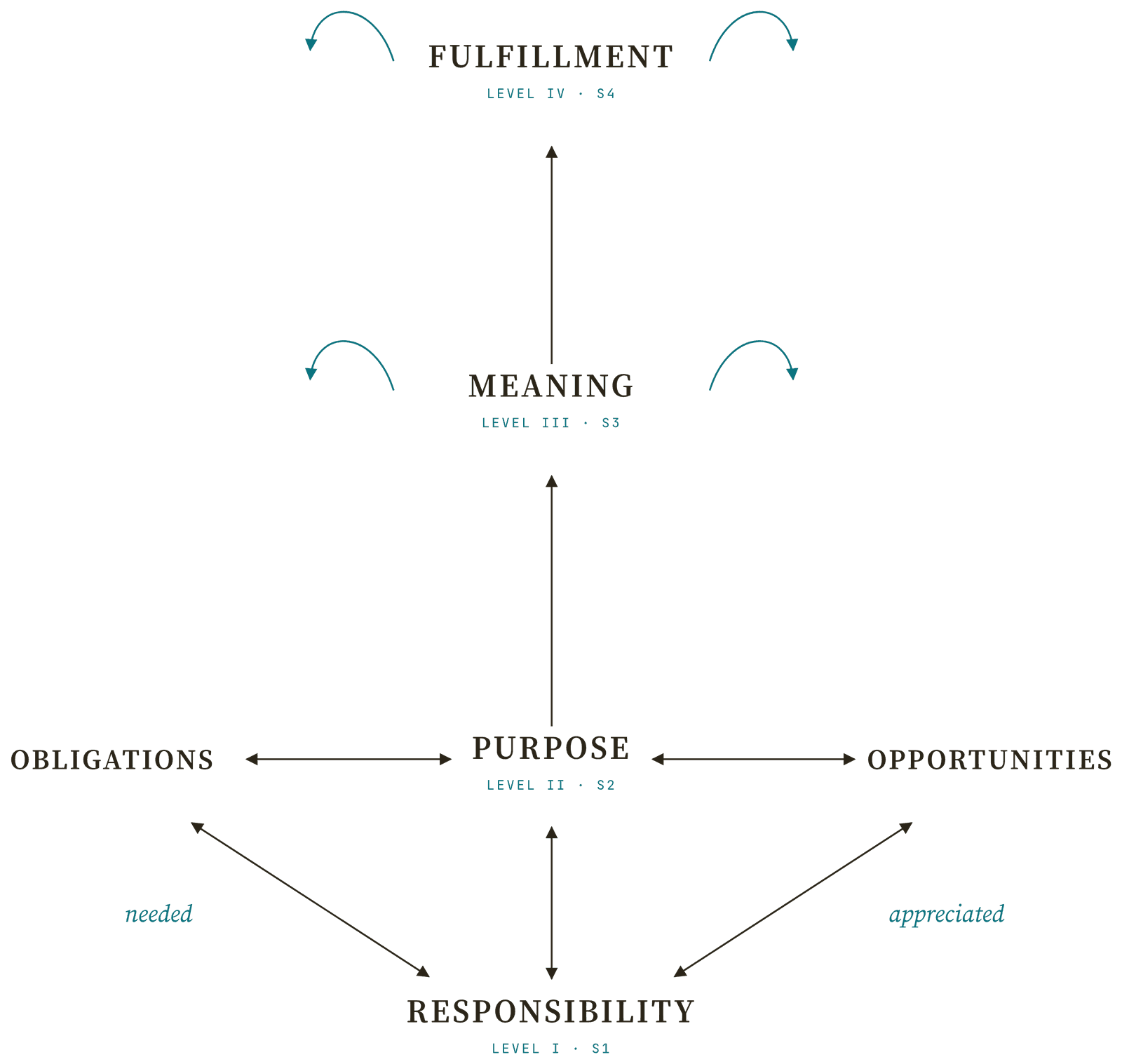
Viktor Frankl's logotherapy focused on the essential nature of responsibility in determining the health and well-being of the individual. In fact, the basis for his existential analysis (i.e. his psychoanalytic perspective) is determined by the degree of man's consciousness of his responsibility. The greater the awareness of one's responsibility, according to Frankl, the greater the health of the individual; he seemingly cared little, if at all, for how one responds to that responsibility. It is at this point of “burden” that we begin towards an existential cornucopia.
02Level I — Responsibility
Level I may be considered an individual's soil for growth. This soil is composed of the particular responsibilities we learn to honor in life. Inasmuch as the environment is constantly changing, responsibility is a contextual consideration in which there are a number of obligations and opportunities; how we view these and respond to them will determine our purpose.
Obligations and opportunities are increasingly a part of our life. There is a recursive nature in the relationship between our obligations and the degree we are needed by others; the more we fulfill our obligations, the more we are needed and the more we do so, our responsibilities increase accordingly. Our opportunities may be defined as those instances in which we may act in a “selfless” manner; the more “altruistic” is our conduct, the more we are appreciated by others (I have quotation marks because nothing is truly selfless or altruistic; inevitably, personal benefits accrue to these actions). Our initiative in this regard increases our responsibilities in the same recursive way that we increase our obligations.
03Level II — Purpose
Fortunately or unfortunately, whatever the case may be, our responses are influenced heavily, particularly in early development, by our immediate environment. We operate much like the mice of Purposive Behaviorism in which learning is situational and reward-based. If we are fortunate, our motive for learning will be based more in acquiring an abundance rather than satisfying a deficiency. Otherwise, we learn early in life to react to circumstances instead of acting in anticipation of them. It is at this fundamental distinction that we find the beginnings of our purpose in life. Admittedly, life is more of a “both/and” situation than an “either/or”, however, level II places us on a continuum between that of an antagonist and a protagonist.
One can view all four levels of individual development as being a reflection of Bruenlin's sequences. Development at level I is the result of personal and situational interactions (S1). These interactions determine, largely, our routines (S2) that define level II. Generally speaking, our routines may be characterized as being in harmony with our surroundings or at odds with it. Accordingly, a therapist may see the beginnings of pathology in a patient at this point.
04Level III — Meaning
Likewise, level III can be seen as the patterns (S3) that have become predominant in our lives. To one degree or another, this level constitutes the extent of growth or development for personkind; this is adulthood, the cumulative effect of all that we have learned. Whatever way we choose to define our reality and relate to it is manifested, more or less irrevocably, at level III. The challenge for the therapist (and patient alike) is to redefine responsibility and reframe obligations and opportunities; to do so is to redefine our meaning of life and participation in it. Successful redefinition of responsibility eliminates the presenting problem and hopefully moves us towards greater fulfillment.
05Level IV — Fulfillment
This personal fulfillment characterizes level IV. It is similar to the self-actualization of Abraham Maslow and embodies constructive transgenerational influences (S4). This fulfillment is the reconciliation of all conflicts regarding our responsibility in life. There is no longer distinctions between who we think we are, what others see us to be and who we actually are; the mind, body and spirit act as one. We have grown beyond the dichotomy of obligation versus opportunity as defining our purpose in life. There are no more obligations, only opportunities, opportunities for service. The purpose of our existence is to serve and in that service we come to understand ourselves in relation to all that surrounds us; the irony is that we have abdicated all personal responsibility. That understanding is the basis of our existential cornucopia.
06Sources
For the full bibliography of scholarly sources, see the Research Bibliography.
- 1.Bateson, G. (1979). Mind and Nature. New York: E. P. Dutton.
- 2.Bateson, G. (1972). Steps to an Ecology of Mind. Northvale, NJ: Jason Aronson.
- 3.Bruenlin, D. C., Schwartz, R. C., & Mac Kune-Karrer, B. (1992). Metaframeworks. San Francisco: Jossey-Bass.
- 4.Chaplin, J. P. (1968). Dictionary of Psychology. New York: Dell Publishing.
- 5.Frankl, V. (1978). The Unheard Cry for Meaning. New York: Simon and Schuster.
- 6.Frankl, V. (1957). The Doctor and the Soul. New York: Alfred A. Knopf.
- 7.Fromm, E. (1947). Man for Himself. New York: Holt, Rinehart and Winston.
- 8.Keeney, B. P. (1983). Aesthetics of Change. New York: Guilford Press.
- 9.May, R. (1953). Man's Search for Himself. New York: W. W. Norton and Company.
- 10.Sartre, J. P. (1957). Existentialism and Human Emotions. New York: Philosophical Library.
- 11.Sartre, J. P. (1953). Existential Psychoanalysis. New York: Philosophical Library.
- 12.Scott, N. A., Jr. (1969). Mirrors of Man in Existentialism. New York: Collins.
- 13.Watzlawick, P., Weakland, J. H., & Fisch, R. (1974). Change. New York: W. W. Norton and Company.